News That Matters To Africa©️
QUOTE OF THE DAY
“A dream you dream alone is only a dream. A dream you dream together…is reality.”
HIGHLIGHTS
Rwanda quits Central African bloc
Interpol issues red notice for Ghana ex-finance minister
Former Zambian President Lungu dies
Ghana endorses Morocco for Western Sahara
Chad announces suspension of visas to US citizens
Trump travel ban
Relief for current visa holders from African
DRC, Liberia elected to UN Security Council.
TOP NEWS
AFRICA-WIDE ISSUES
AFRICAN DIASPORA
UN-AFFAIRS
EASTERN AFRICA
DJIBOUTI
Group stranded with ICE in Djibouti shipping container after removal from US
A group of men removed from the US to Djibouti, in east Africa, are stranded in a converted shipping container together with the US Immigration and Customs Enforcement (ICE) officers sent to supervise them after a deportation flight to South Sudan was stopped by an American court. The eight deportees and 13 Ice staff have begun to “feel ill”, the US government said. Eight men, from Latin America, Asia and South Sudan, and the Ice staff have been stuck at a US naval base since late May. The Department of Homeland Security (DHS) said that the Ice officers began to fall ill “within 72 hours of landing” in Djibouti, and continue to suffer from suspected bacterial upper respiratory infections. The Trump administration had attempted to send the eight detainees, who it said had been convicted of criminal offenses, to South Sudan, but a judge intervened to stop their flight in May, arguing that they were entitled to challenge the deportation in the courts. Mellissa Harper, a top official at the DHS and Ice, said in a court declaration that the detainees are being held in a shipping container that was previously converted into a conference room. The Ice officers are “sharing very limited sleeping quarters”, Harper said, with only six beds between 13 people. She said the outside temperature frequently exceeds 100F (38C) in the daytime, and said ICE officials were at risk of malaria because they did not take anti-malaria medication before arriving in Djibouti. “Within 72 hours of landing in Djibouti, the officers and detainees began to feel ill,” Harper said, but they were unable to obtain proper testing for a diagnosis.
DR CONGO
Students in rebel-held eastern Congo brave insecurity to take exams
Tens of thousands of secondary school students sat for state exams in rebel-held eastern Congo this week, a complicated logistical feat requiring rare cooperation between the government and M23 rebels. The insurgents seized eastern Congo’s two largest cities in an offensive earlier this year and are now trying to show they can govern. African leaders along with Washington and Doha are meanwhile trying to broker a peace deal that would put an end to a conflict with roots in the Rwandan genocide more than three decades ago. The state exams, administered across the sprawling central African country for students hoping to go to university, began on Monday and will continue through mid-June. Administering them throughout the east of Democratic Republic of Congo required having education officials personally escort documents and other materials from the capital Kinshasa into M23-held cities and towns. President Felix Tshisekedi’s government announced last month it was waiving exam fees – which normally exceed $40 – for students in North and South Kivu provinces, citing insecurity.
KENYA/UGANDA
Sun sets on refugees in Uganda, Kenya as UN body runs out of food and cash
Uganda hosts about 1.8 million refugees from at least five African countries. The idea of taking in refugees was based on donors continuing to send in basics. Now that may change after US President Donald Trump cut aid to humanitarian bodies and sent shock waves into the UN agencies. The United Nations High Commissioner for Refugees (UNHCR) and the World Food Programme (WPF), have been the earlies agencies to raise alarm. WFP had already warned that refugees in Kenya are at risk of increased food insecurity due to critical funding shortages, forcing the agency to reduce food assistance to the lowest levels ever recorded. According to the agency, 720,000 refugees in Kenya rely on their support. Yet, unless more funding arrives, starting this month, food rations will be slashed to just 28 percent, and cash assistance will be cut entirely. Over the past five years, the number of refugees and asylum seekers in Kenya has increased by over 70 percent, according to the WFP, rising from around 500,000 to 843,000 as people have fled conflict and drought in neighbouring countries such as Somalia and South Sudan.
OpEd: US funding cuts push Eastern Africa to the brink of a humanitarian catastrophe
KENYA
British soldier arrested in Kenya over rape allegation
A UK soldier has been accused of raping a woman near a British army training camp in Kenya where another soldier was previously accused of murder. The alleged rape happened last month close to the British Army Training Unit Kenya (Batuk) near the town of Nanyuki, 200km (125 miles) north of the capital, Nairobi. The man was arrested and questioned following the alleged incident, which occurred after a group of soldiers visited a bar in the town. An investigation is being carried out by UK military police from the Defence Serious Crime Unit, which looks into crimes allegedly committed by British service personnel in the UK and overseas. This follows previous allegations that a soldier stationed in Kenya was involved in the murder of a local woman in 2012. The body of Agnes Wanjiru, who was 21 and a mother of one, was found in a septic tank near the Batuk base three weeks after she disappeared, allegedly after spending the evening with British soldiers. The Sunday Times reported in 2021 that a British soldier was believed to have been responsible for her murder.
Kenya tells tea factories to cut ties with Rainforest Alliance
The Kenyan government has told its tea factories to stop working with the Rainforest Alliance because it says the costs involved in securing the ethical label don’t add up for farmers. The non-profit organisation is one of the world’s most recognisable certification schemes with its green frog seal on food packaging a sign consumers “can feel confident that these products support a better world”. However the world’s third largest tea producer has ordered tea factories to suspend certification work because the cost is adding to the financial strain on struggling smallholders. A recent Fairtrade Foundation poll found only one in five tea workers and farmers in Kenya are earning enough each month to support their families with essentials. Rainforest Alliance is a global non-profit organisation that works to promote sustainable agriculture, forestry and responsible business practices. The green frog seal appears on nearly 240 brands and is almost ubiquitous in UK supermarket tea ranges with big names including Tetley, PG Tips and Yorkshire Tea among those signed up. About half the tea consumed in the UK comes from Kenya. The widespread demand for ethical certification is linked to the reputational risk of sourcing from tea-producing regions with a long list of problems. These include low wages, unsafe working conditions, gender inequality and environmentally unsustainable practices.
Stadium security in Kenya a concern as CHAN looms
The Swahili word ‘pamoja’, meaning together, has been used to describe Kenya, Tanzania and Uganda hosting the African Nations Championship (CHAN), but the neighbours are not in sync when it comes to their level of preparedness for the finals in August. It is set to be the first time a continental competition is co-hosted by three countries, yet the tournament for domestic-based players has already been postponed once because works on infrastructure and facilities had not been finalised. One top Confederation of African Football (Caf) official says Kenya is “90%” ready, but has warned progress must continue and that stadium safety and security issues need addressing… Crowd control during big matches in Kenya has been an area of concern in recent months. In March, fans forced their way into the Nyayo National Stadium during Kenya’s 2026 World Cup qualifier against Gabon by breaking a gate. That incident came during what was the Harambee Stars’ first game on home soil in almost two years. Caf general secretary Veron Mosenga-Omba admits that while such a lapse after a long absence of hosting international football is “understandable”, it is “not acceptable”. With the 2027 Africa Cup of Nations (Afcon) also set to be co-hosted by Kenya, Tanzania and Uganda, Caf is already taking measures to ensure security standards are met for CHAN.
Kenya exempts dozens of visitors from eTA requirement
In a notice dated May 30, 2025, Interior and National Administration Cabinet Secretary Kipchumba Murkomen introduced the Kenya Citizenship and Immigration (Amendment) Regulations, 2025. The new rules, made under Section 59 of the Kenya Citizenship and Immigration Act, add Regulation 15G, which outlines categories of persons exempted from the eTA requirement. The new regulation under the Seventeenth Schedule lists 34 categories of persons who can now travel to Kenya without first obtaining an Electronic Travel Authorisation (ETA). These include holders of Kenyan permanent residence, valid work permits and re-entry passes, as well as citizens from East African Community (EAC) partner states.
Ngũgĩ wa Thiong’o obituary
RWANDA
Rwanda quits Central African bloc in dispute with Congo
Rwanda has said it would withdraw from the Economic Community of Central African States (ECCAS), underscoring diplomatic tensions in the region over an offensive this year by Rwanda-backed M23 rebels in eastern Congo. Kigali had expected to assume the chairmanship of the 11-member bloc at a meeting on Saturday in Equatorial Guinea. Instead, the bloc kept Equatorial Guinea in the role, which Rwanda’s foreign ministry denounced as a violation of its rights. Rwanda, in a statement, condemned Congo’s “instrumentalization” of the bloc and saw “no justification for remaining in an organization whose current functioning runs counter to its founding principles.”
SOMALILAND
OpEd: Somaliland is open to trade, innovation and dialogue
SOUTH SUDAN
Kiir Reconstitutes Committee on Peace Implementation
In a twist of events, President Salva Kiir reconstituted the High-Level Ad Hoc Committee on the Implementation of the Revitalized Agreement on the Resolution of the Conflict in South Sudan (R-ARCSS) on Wednesday night…Senior Presidential Advisor Gen. Kuol Manyang Juuk of the SPLM is the chairperson of the new body and will be deputized by Lasuba Ludoru Wongo of the SPLM-IO. At the same time, Dr. Martin Elia Lomuro of the National Agenda was named Secretary General…It was not explicitly stated in the order if the new committee assumes the role of the National Transitional Committee (NTC), which is mandated to superintend the implementation of the 2018 revitalized peace agreement. The NTC was reconstituted in January and has eleven members, chaired by Senior Presidential Advisor Gen. Kuol Manyang.It is important to note that in President Kiir’s latest move, he excluded SPLM/A-IO members who are loyal to First Vice President Dr. Riek Machar, who is under house arrest.
South Sudan imposes emergency as herder clashes kill hundreds
South Sudan’s President Salva Kiir on Thursday declared a state of emergency in areas hit by deadly inter-communal clashes over cattle raids that have killed hundreds of people in recent months, state TV said. Cattle raids and clashes over scarce water and grazing land are common in the impoverished east African nation, often exacerbated by extreme weather such as droughts and floods…The UN said on Tuesday that violence between herders in Tonj County, Warrap State, has become frequent, with cattle raids and revenge attacks killing hundreds since December — including over 200 in March and about 80 in recent days…The clashes come on top of politically and ethnically driven violence that continues to destabilise the world’s youngest nation, which gained independence from Sudan in 2011. Several embassies in early May warned of a deterioration in South Sudan’s security following months of fighting between forces loyal to President Kiir and First Vice President Riek Machar.
SUDAN
Sudan’s ‘Hemedti’ rules out further Jeddah talks, vows escalation
Mohamed Hamdan “Hemedti” Dagalo, commander of Sudan’s paramilitary Rapid Support Forces (RSF), has announced his “categorical refusal” to participate in any new round of negotiations in the Saudi coastal city Jeddah, vowing to intensify fighting. The Jeddah Platform — initiated on May 6, 2023, less than a month after fighting erupted in mid-April 2023 between the Sudanese Armed Forces (SAF) and the RSF — was coordinated by Saudi Arabia and the United States. The forum has held three rounds of talks, the last concluding in December 2023. The SAF has consistently rejected negotiations with the RSF until it implements measures which include the withdrawal of RSF forces from all areas and their consolidation in designated zones…The announcement comes as military operations escalate in West Kordofan, where the RSF recently seized control of El Khawi, El Dabibat, El Hamadi, and other areas. Hemedti threatened to attack El Obeid, the capital of North Kordofan, and Sudan’s Northern State, urging civilians to “remain indoors and secure their property”.
Sudan faces rapidly-spreading cholera outbreak, 1000 daily cases in capital
A fast-spreading cholera outbreak has hit Sudan with officials reporting more than 1,000 cases a day in the capital of the war-torn country. The outbreak is centred around the capital, Khartoum, and has spread as many Sudanese who had fled the country’s war return home. Residents are often only able to find unclean water – which is a dangerous conduit for the disease – as much of the sanitation system has collapsed amid the civil war. Cholera was also detected in the provinces of North Kordofan, Sennar, Gazira, White Nile and Nile River, health officials said. Since then, some 34,000 people have returned. But the city (Khartoum) has been wrecked by months of fighting. Many found their homes damaged. Clean water is difficult to find, in part because attacks on power plants have disrupted electricity and worsened water shortages, UNICEF said. Sanitation systems are damaged.
Donors condemn attacks on civilians, aid workers
The UK, and 29 other countries condemned attacks against civilians and humanitarian workers in Sudan, according to a joint donor statement on Friday. The donor countries said they “condemn in the strongest terms” the attack on a humanitarian convoy of 15 trucks from the World Food Program (WFP) and the UNICEF in Al Koma, North Darfur, on the night of June 2. Recalling that the attacks resulted in the death of five members of the convoy and injuring several others, it said that four of the 15 trucks in the convoy were destroyed in the attack and five more sustained partial damage. “These trucks were carrying about 100 metric tonnes of essential nutrition, health, education, and WASH supplies, intended to support children and families in El Fasher town,” read the statement… The statement also reiterated their call to the Sudanese Armed Forces, the Rapid Support Forces (RSF) and their militias to “immediately cease hostilities” and uphold their obligations towards international humanitarian law.
How Bashir loyalists hijacked Sudan conflict and stifled dialogue
Sudan’s military junta under Gen Abdel Fattah al-Burhan has often blamed other entities; rivals in the Rapid Support Forces (RSF) and some foreign countries, for prolonging the conflict. But within the junta itself, there have been elements preventing any meaningful dialogue. This year, for example, there has been little movement to end the war, even though external parties such as the US and Saudi Arabia have tried to push the levers and invite talks. The latest effort, last month, was when Burhan’s side declined an invite to Jeddah. Why has this cycle continued? Experts say the problem in Sudan is an old one, that of Islamist movements hijacking national institutions and controlling them… But while the Bashir figures publicly backed the SAF during the war, they were, in fact, undermining its ability to function as a government or engage in ending the conflict. First, they ensured SAF disowned regional dialogue pushes. Then they ensured dealings with civilian movements were halted. Islamists began rebranding themselves as a patriotic force defending the state and national unity—positioning themselves in contrast to the RSF, which they accuse of pursuing a regionalist agenda and destabilising the nation.
TANZANIA
Govt says X Is blocked over pornographic content – critics says its over politics
Tanzania has blocked access to the social media platform X, formerly Twitter, citing the presence of pornographic material that violates national laws and cultural norms, officials confirmed on Wednesday. Information Minister Jerry Silaa told a local television station that the government’s decision was based on X’s policy allowing “consensually produced and distributed” adult content. He argued that such material, including depictions of homosexuality, is incompatible with Tanzanian laws and traditional values. While authorities have linked the shutdown to content violations, the move comes following mounting criticism of the government’s tightening grip on opposition voices ahead of elections in October. Access to X was cut off on May 20, coinciding with the hacking of official government accounts, Tanzania has a history of limiting access to social media platforms during politically sensitive periods.
UGANDA
World Bank to resume Uganda funding after halt over anti-LGBT law
The World Bank said on Thursday it would resume funding to Uganda, nearly two years after the global lender suspended new financing to the country in response to an anti-LGBT law that imposes penalties including death and life imprisonment. The bank halted funding to the East African country in August 2023 after Uganda’s parliament passed the Anti-Homosexuality Act (AHA), saying the law contradicted its values. The bank had worked with Ugandan authorities to put in place strong measures to mitigate against potential harm from the law, a World Bank spokesperson told Reuters via email. “We have now determined the mitigation measures rolled out over the last several months in all ongoing projects in Uganda to be satisfactory,” said the spokesperson, who asked not to be named. The World Bank is one of Uganda’s biggest sources of external financing, especially in infrastructure construction in the transport sector. AHA mandates the death penalty for so-called “aggravated homosexuality”…
Uganda takes control of 2 DRCongo towns
The Ugandan army said Thursday it had taken control of the Democratic Republic of Congo towns of Kasenyi and Tchomia to “prevent inter-ethnic fighting”. While Rwanda backs the M23 armed group that has taken huge swathes of the mineral-rich eastern DRC in recent months, neighbouring Uganda has played a more complex role. Uganda has worked alongside the DRC government to fight Islamist insurgents in the region. But analysts say it is also keen to secure economic advantages, including control of Congolese gold mines and wider trade…[Kasenyi and Tchomia] are towns in DRC’s Ituri province, on the vast Lake Albert that separates Uganda and DRC and is the site of a massive oil exploration project being constructed by Uganda with French firm TotalEnergies and the China National Offshore Oil Corporation.
WEST AFRICA
BURKINA FASO
Why Traoré’s gold gambit is a gilt-edged lesson in Pan-Africanism
Burkina Faso is shaking up the status quo by rewriting mining laws, nationalizing operations, and renegotiating contracts with foreign firms in a bid to reclaim control of its vast gold reserves. In West Africa for decades: international companies extract gold worth billions of dollars, while local communities reap scant benefits from it. Burkina Faso, under the leadership of Captain Ibrahim Traoré, is trying to flip that script with a pan-Africanist approach. The country sits on some of Africa’s largest gold reserves, yet most profits have enriched overseas shareholders rather than contributing meaningfully to local economies and creating jobs, according to experts. Since taking power in a 2022 coup d’état, Traoré’s government has rewritten mining laws, nationalized some operations, and renegotiated contracts to squeeze more revenue from mining companies. The 37-year-old President, currently the world’s youngest head of state, terms it a “revolution”. Reactions emerging from the West have been understandably salty, especially with gold prices hitting record highs this year.
GABON
Gabon withdraws from EU fisheries deal after nearly 20 years, citing economic concerns
Gabon has announced its decision to withdraw from a long-standing fisheries partnership agreement with the European Union, ending nearly two decades of cooperation over marine resources. The West African nation, which entered the deal in 2007, says the agreement has disproportionately benefited European fishing fleets at the expense of its own economy and environment. President Brice Clotaire Oligui Nguema criticised the arrangement as “lopsided,” saying Gabon has gained little despite European vessels exploiting its territorial waters for years. Under the pact, EU fishing vessels were granted access to Gabonese waters in return for financial contributions aimed at supporting Gabon’s fisheries sector. However, Libreville now argues that the promised benefits, such as investment, job creation, and industrial growth, have not materialised. The government said it is particularly concerned that most of the fish caught under the agreement are shipped directly to Europe without being landed or processed locally. Officials say this practice has denied Gabon crucial opportunities to build a domestic fish processing industry and generate employment.
GHANA
Interpol issues red notice for Ghana ex-finance minister over corruption claims
nterpol has issued a “red notice” for Ghana’s former finance minister, according to website records reviewed Friday, as he faces accusations of using public office for personal gain. Ken Ofori-Atta is under investigation over a string of high-profile contracts, including deals related to Ghana’s petroleum revenues, electricity supply, ambulance procurement and a controversial national cathedral project that, tens of millions of dollars later, has yielded little more than a hole in the ground excavated by construction crews. The Interpol notice follows a formal request by Ghana’s Office of the Special Prosecutor (OSP), which re-declared Ofori-Atta a wanted person on Monday after he failed to appear for a scheduled interrogation. A red notice is a request to police worldwide to arrest a suspect. Extradition proceedings are reportedly under way to return him to Ghana, though his exact location remains unclear as he reportedly seeks medical treatment abroad.
LIBERIA
Liberia’s ex-speaker charged with arson over parliament fire
Liberia’s former speaker of parliament has been charged with arson over a fire which destroyed the nation’s House of Representatives, local police have said. The huge blaze broke out last December, a day after plans to remove Jonathan Fonati Koffa from his role as speaker sparked protests in the capital, Monrovia. Koffa had been locked in a stand-off with his political opponents, with dozens of lawmakers voting for his impeachment in October over accusations of poor governance, corruption and conflicts of interest. Police said on Friday that there were “credible links” to suggest Koffa was “strategically involved” in the incident. Five other lawmakers have also been detained in connection with the case. Koffa and several other lawmakers were summoned to the Liberian National Police headquarters on Friday as “persons of interest” in the case, local media reports. The former speaker and three sitting members of the House of Representatives were then remanded to Monrovia Central Prison on Saturday. The blaze on 18 December 2024 destroyed the entire joint chambers of the West African nation’s legislature. No one was inside the building at the time.
MALI
Africa Corps to stay in Mali after Russia’s Wagner mercenary group leaves
The Africa Corps, a Kremlin-controlled paramilitary force, said on Friday it will stay in Mali after Russia’s Wagner mercenary group leaves following a 3-1/2 year fight against Islamist militants. Wagner has been in Mali since the army, which seized power in two coups in 2020 and 2021, kicked out French and United Nations troops involved in fighting Islamic insurgents for a decade. The Africa Corps was created with the Russian Defence Ministry’s support after Wagner founder Yevgeny Prigozhin and commander Dmitry Utkin led a failed military mutiny against the Russian army leadership and left Russia for Belarus with other mercenaries. About 70-80% of the Africa Corps is made up of former Wagner mercenaries, according to several Telegram chats used by Russian mercenaries. Wagner posted on social media that it was returning home after its mission in Mali had been successfully completed. It added it had brought all of the country’s regional centres back under the control of the Malian military junta, pushing out Islamist forces and killing their commanders. The Africa Corps said on its Telegram channel that Wagner’s departure would not introduce any changes as the Russian contingent will remain in Mali.
NIGER
Red Cross halts operations in Niger after government directive
The International Committee of the Red Cross says it has suspended its operations in Niger after the West African nation’s government ordered the closure of its offices, citing alleged collusion with armed groups. Niger junta leader Abdourahamane Tchiani said in an interview with state television in late May that the organisation had been expelled in February, accusing it of meeting and collaborating with Islamist insurgent leaders. The ICRC denied the allegations. “To fulfil its humanitarian mandate to protect and assist victims of armed conflict, the ICRC engages in a spoken or written dialogue with all parties to a conflict,” it said in a statement. The organisation said it “never provides those parties with financial, logistical or other support.” The ICRC, which has worked in Niger for 35 years, said it regretted the government’s decision.
NIGERIA
Court jails nine Chinese nationals for cybercrime, economic sabotage; orders deportation
The Federal High Court in Lagos has convicted and sentenced nine Chinese nationals, including two women, to one year imprisonment each for economic sabotage and financial terrorism. The trial judge, Daniel Osiagor, handed down the sentences after the convicts entered into a plea bargain agreement with the Economic and Financial Crimes Commission (EFCC)…Their conviction follows the 10 December 2024 raid by EFCC operatives on the sixth floor of a building on Oyin Jolayemi Street, Victoria Island, Lagos. The operation, described by the agency as its largest single-day cybercrime crackdown, resulted in the arrest of over 700 individuals, including 158 foreign nationals, for alleged involvement in cyber terrorism and economic sabotage…According to the EFCC, the convicts were part of a cybercrime syndicate that accessed computer systems to destabilise Nigeria’s economic and social structures. They were accused of recruiting Nigerian youths to commit identity theft and pose as foreign nationals for financial fraud. The sentencing of the Chinese nationals follows a string of convictions stemming from the December 2024 cybercrime raid. PREMIUM TIMES reported that another Federal High Court in Ikoyi, Lagos, convicted eight Filipino nationals of similar offences.
SENEGAL
Khaby Lame: Senegalese-Italian TikTok star leaves US after detention
US immigration agents detained and later allowed the “voluntary departure” of the world’s most-followed TikToker, Khaby Lame, after he “overstayed” his visa, authorities said. “US Immigration and Customs Enforcement detained Seringe Khabane Lame, 25, a citizen of Italy, June 6, at the Harry Reid International Airport, Las Vegas, Nevada for immigration violations,” the agency said in a statement on Saturday. Lame, a Senegalese-Italian, entered the United States on April 30 and “overstayed the terms of his visa”, the statement said of the Friday detention, adding that he was released the same day. Khaby Lame, is a UNICEF goodwill ambassador and has a following of more than 162 million on TikTok, rose to fame for his short silent videos mocking the convoluted tutorials and tips that abound on the internet. “He has since departed the US.
TOGO
Togolese artist, who police said was ‘arrested for treatment’, apologises for criticizing president
Aamron, a Togolese rapper known for criticising President Faure Gnassingbe’s rule, reappeared on Thursday in a video apology after more than a week in detention, where police said he was being “treated.” Aamron, whose real name is Essowe Tchalla, was taken into custody from his home in the capital, Lome, on May 26, hours after he called for a satirical mobilisation on June 6 to mark President Faure Gnassingbe’s birthday, his mother said on social media. The arrest sparked outrage from opposition groups and civil society, who denounced what they called a crackdown on dissent. Gnassingbe has led Togo since 2005, succeeding his father who ruled for nearly four decades. He recently consolidated power by shifting to a parliamentary system with himself at the helm.
REGION
A powerful, opaque al-Qaeda affiliate is rampaging across West Africa
In the space of just a few months, the al-Qaeda affiliate has overrun major cities in Burkina Faso and Mali, carried out the deadliest-ever attack on soldiers in Benin and expanded its hard-line Islamist rule across the region. No one knows when its fighters will strike next — or where they plan to stop. After years spent quietly gaining strength, Jama’at Nusrat al-Islam wal-Muslimin (JNIM) is now the most well-armed militant force in West Africa and among the most powerful in the world, according to regional and Western officials, with as many as 6,000 fighters under its command. Local strategies employed to combat JNIM are accelerating its rise, officials and experts say, as atrocities by West African forces have allowed the group to claim the moral high ground and legitimize its growing authority. The United States has largely pulled back from — or been pushed out — of the fight, leaving in its wake a deepening security vacuum and mounting anxiety over JNIM’s aims and capabilities. JNIM, along with the rival Islamic State-Sahel Province, has turned the region into an epicenter of Islamist insurgency. The Institute for Economics & Peace’s annual index last year found 51 percent of terrorism deaths worldwide were in the Sahel, a vast, tumultuous region south of the Sahara that spans the breadth of Africa. The chaos ravaging the region has helped military officers seize power in coups — vowing to break with the West and restore calm.
SOUTHERN AFRICA
ANGOLA
Angola seizes 30,000 firearms from security companies
Angolan police, in an operation conducted over 100 consecutive days, said they had confiscated over 30,000 military grade firearms held by private security companies. The operation is aimed at increasing control and safety within the security sector. More than 1,700 security companies operate in Angola, according to the police, and last year they were asked to voluntarily hand over weapons that did not meet legal criteria and replace them with authorized firearms. The latest seizure operation was launched in February after only 1,548 weapons were handed over, with more than 40,000 still missing. The resulted in the seizure of 31,392 military grade weapons held by private security companies,” a police spokesperson said. Angola has for decades tried to rid itself of illegal firearms, many of which remain from the 27-year civil war that ended in 2002. In 2008, over 200,000 illegal weapons were collected in a civilian voluntary disarmament plan. Unauthorised firearms in circulation risked ending up in the hands of criminals, the police said.
BOTSWANA
Botswana cuts back on diamond production amid weak global demand
Fewer diamonds from the mines: Botswana will cut back its 2025 output of diamonds by 16% in comparison to the year before. With global demand for diamonds falling and lab-grown diamonds becoming a cheaper alternative, diamond mining companies are struggling. And for a country like Botswana, where diamonds make up 80% of its export revenue, this situation is especially hard-hitting. Debswana, which is Botswana’s largest diamond production company, accounting for 90% of sales, saw its revenue drop by almost half last year. Faced with the weak global demand, Debswana announced in May that it would temporarily pause production at its flagship Jwaneng mine as well as at the Orapa mines, the world’s largest by area. To give the economy a small boost, Botswana’s president has called for diamonds to be polished and cut locally instead of exporting the precious stones raw.
SOUTH AFRICA
Tributes to South African ‘Tsotsi’ star Presley Chweneyagae at funeral
Friends and colleagues of South African actor Presley Chweneyagae, star of the Oscar-winning South African film “Tsotsi”, have paid tribute to him at his funeral service. Chweneyagae died at the age of 40 at his home, his agent announced on Tuesday. The actor gained international fame in 2006 when the movie “Tsotsi” , set in the criminal underworld of Johannesburg’s sprawling township of Soweto, scooped the best foreign film award. His funeral service was held on Saturday at the Akasia Community Hall in the capital, Pretoria, where he had lived.
South Africa’s deputy minister of sports and culture, Peace Mabe, described Chweneyagae as a “gifted thespian who left an indelible mark on many people’s lives and touched many hearts”.
On the hunt for ‘Tiger’, linked to illegal gold mine where 78 died
Nobody in South Africa seems to know where ‘Tiger’ is. The 42-year-old from neighbouring Lesotho, whose real name is James Neo Tshoaeli, has evaded a police manhunt for the past four months. Detained after being accused of controlling the illegal operations at an abandoned gold mine near Stilfontein in South Africa, where 78 corpses were discovered underground in January, ‘Tiger’ escaped custody, police allege. Four policemen, alleged to have aided his breakout, are out on bail and awaiting trial, but the authorities appear no closer to learning the fugitive’s whereabouts. In Lesotho, his brother and mother have not seen ‘Tiger’ in eight years – nor do they believe he was a ‘ring leader’. Sentiments echoed by others who knew him. A friend says: “He was a boss underground, but he’s not a top boss. He was like a supervisor, someone who could manage the situation where we were working.” Mining researcher Makhotla Sefuli thinks it was unlikely that ‘Tiger’ was at the top of the illegal mining syndicate in Stilfontein. He says those in charge never work underground…At the top are “some very powerful” people, with “close proximity to top politicians”. These people make the most money, but do not get their hands dirty in the mines.
DNA from 9,000-year-old skeletons disproves migratory waves theory from South Africa
DNA from nine prehistoric skeletons, dated as far back as about 9,000 years ago, shows that early inhabitants near the southern Cape Province of South Africa experienced minimal population changes over many millennia. Researchers extracted and analyzed the ancient DNA of individuals from different layers of the site to piece together their genetic profiles. According to lead investigator Dr. Joscha Gretzinger from the Max Planck Institute for Evolutionary Anthropology, these people displayed a shared genetic heritage that stayed relatively stable until around 1,300 years ago. Archaeologists once assumed that outside groups had entered the region in multiple migration waves. That assumption has now been challenged by ancient South African DNA from the nine skeletons that span much of the holocene, a geological epoch that began roughly 11,700 years ago. Each skeleton revealed a highly consistent genetic signature, a pattern that points to continuity across thousands of years.
ZAMBIA
Former Zambian President Lungu dies aged 68
Zambia’s former President Edgar Lungu has died at the age of 68, his party has said in a statement. He had “been receiving specialized treatment in South Africa” for an undisclosed illness, the Patriotic Front (PF) added. Lungu led Zambia for six years from 2015, losing the 2021 election to the current President Hakainde Hichilema by a large margin. After that defeat he stepped back from politics but later returned to the fray. He had ambitions to vie for the presidency again but at the end of last year the Constitutional Court barred him from running, ruling that he had already served the maximum two terms allowed by law. Even after being disqualified from running once more for the presidency, he remained hugely influential in Zambian politics and did not hold back in his criticism of his successor…Lungu first became president in January 2015 after winning a special presidential election triggered by the death in office of Michael Sata. After completing Sata’s term, he won a further five years in power in 2016 taking just over 50% of the vote…Lungu lost in 2021 by close to a million votes with Hichilema, seen as more pro-Western, tapping into widespread dissatisfaction among the electorate…Lungu was a lawyer by training but enjoyed a meteoric rise in politics after winning a seat in parliament as a PF MP in 2011. He entered government as deputy minister in the vice-president’s office in that year and rose to become minister of home affairs in just over 12 months.
NORTH AFRICA

LIBYA
UN says dozens of bodies discovered in a section of Libyan capital run by armed militia
The United Nations human rights office expressed concerns on Wednesday about the discovery of dozens of bodies, some charred and buried and others in hospital refrigerators, in an area of Libya’s capital controlled by an armed militia whose leader was killed last month. U.N. High Commissioner for Human Rights Volker Türk said he was shocked by revelations that gross rights violations were uncovered at detention facilities in Tripoli run by the Stabilization Support Authority, or SSA, an armed group whose commander Abdel-Ghani al-Kikli, was killed in militia fighting in mid-May. The rights office said it later received information on the excavation of 10 charred bodies at the SSA headquarters in the Abu Salim neighborhood and another 67 bodies discovered in refrigerators in the Abu Salim and Al Khadra hospitals. It also cited reports of a burial site at the Tripoli Zoo that was run by the SSA.
MOROCCO
Ghana endorses Morocco’s autonomy plan for Western Sahara
Ghana said on Thursday it views a Moroccan autonomy plan as the sole basis to settle the Western Sahara dispute within the framework of the UN, aligning itself with a growing number of Western, African and Arab countries that back Rabat’s position on the dispute. The long-frozen conflict pits Morocco, which considers the desert territory as its own, against the Algeria-backed Polisario front, which seeks an independent state there. Ghana considers the autonomy plan “as the only realistic and sustainable basis to a mutually agreed solution to the issue,” said a joint statement issued after talks between Ghana’s foreign minister, Samuel Okudzeto Ablakwa, and his Moroccan counterpart, Nasser Bourita in Rabat. The UN should remain the exclusive framework for finding a solution to the issue, the statement said. The position was expressed few days after similar stands by Kenya and the UK, reflecting a diplomatic shift in Morocco’s favour.
Drought, rising prices and dwindling herds undercut this year’s Eid al-Adha in North Africa
The cascading effects of climate change have sparked a region-wide shortage of sheep that is being felt acutely as Muslims throughout North Africa celebrate Eid al-Adha. Each year, Muslims slaughter sheep to honor a passage of the Quran in which the prophet Ibrahim prepared to sacrifice his son as an act of obedience to God, who intervened and replaced the child with a sheep. But this year, rising prices and falling supply are creating new challenges, breeders and potential buyers throughout the region say… Amid soaring inflation, sheep can sell for more than $1,200, an exorbitant amount in a country where average monthly incomes hover below $270. Any disruption to the ritual sacrifice can be sensitive, a blow to religious tradition and source of anger toward rising prices and the hardship they bring. So Morocco and Algeria have resorted to unprecedented measures. Algerian officials earlier this year announced plans to import a staggering 1 million sheep to make up for domestic shortages. Morocco’s King Mohammed VI broke with tradition and urged Muslims to abstain from the Eid sacrifice. Local officials across the kingdom have closed livestock markets, preventing customers from buying sheep for this year’s celebrations.
OpEd: How Morocco’s high-stakes gamble on Israel could be its downfall
The regime is trading symbolic legitimacy for strategic gains, at the risk of political implosion
CENTRAL AFRICA
CHAD
Chad announces suspension of visas to US citizens in response to Trump travel ban
Chad’s President Mahamat Idriss Deby has announced that his country will suspend the issuing of visas to U.S. citizens in response to the Trump administration’s decision to ban Chadians from visiting the United States. President Donald Trump on Wednesday resurrected a hallmark policy of his first term when he announced the visa ban on 12 countries including Chad, accusing them of having “deficient” screening and vetting, and historically refusing to take back their own citizens who overstay in the United States. In a Facebook post, Chad’s president on Thursday said he is directing his government to suspend visas to U.S. citizens “in accordance with the principles of reciprocity.” “Chad has no planes to offer, no billions of dollars to give but Chad has his dignity and pride,” Deby said, referring to the $400 million luxury plane offered to his administration as a gift by the ruling family of Qatar.
AFRICA-WIDE ISSUES

Trump travel ban: Relief for visa holders from African countries on list
The State Department instructed US embassies and consulates on Friday not to revoke visas previously issued to people from 12 mainly African and Middle Eastern countries now under President Donald Trump’s new travel ban, which goes into effect next week. In a cable sent to all US diplomatic missions, the department said “no action should be taken for issued visas which have already left the consular section” and that “no visas issued prior to the effective date should be revoked pursuant to this proclamation.” However, visa applicants from affected countries whose applications have been approved but have not yet received their visas will be denied, according to the cable, which was signed by Secretary of State Marco Rubio. And, unless an applicant meets narrow criteria for an exemption to the ban, his or her application will be rejected starting on Monday. During Trump’s first term, a hastily written executive order ordering the denial of entry to citizens of mainly Muslim countries created chaos at numerous airports and other ports of entry, prompting successful legal challenges and major revisions to the policy. The new proclamation, which Trump signed on Wednesday, appears designed to beat any court challenge by focusing on the visa application process.
AU concerned over travel bans impact
The African Union’s Commission expressed concern on Thursday over the potential negative impact of the new travel ban announced by U.S. President Donald Trump on Wednesday announced a ban that is set to prohibit travel to the US from a dozen countries including seven in Africa, alleging security risks. In a statement, the AU Commission said it was concerned about the “potential negative impact” of the measures. In Africa, the Trump’s order specifically prohibits people from Chad, the Republic of the Congo, Equatorial Guinea, Eritrea, Libya, Somalia and Sudan from entering the US. An additional three African countries – Burundi, Sierra Leone and Togo – will face partial restrictions. “The African Union Commission respectfully calls upon the U.S. Administration to consider adopting a more consultative approach and to engage in constructive dialogue with the countries concerned,” it said.
Bodies of 14 African migrants discovered in Venezuela
Authorities in northeastern Venezuela have discovered the bodies of 14 African migrants on a river that connects to the Atlantic Ocean, Interior and Justice Minister Diosdado Cabello said. The decomposing bodies were found on a boat in the northeastern state of Delta Amacuro, according to media reports. “There were 14 human bodies, all from Africa,” Cabello said late Wednesday, adding that some were from Mali and that the victims died of dehydration and hunger…In late May, authorities in the Caribbean island country of Saint Vincent and the Grenadines found 11 bodies on a boat. The victims had Malian passports.
China’s quiet win: Outmaneuvering U.S. for Africa’s future leaders
When students in Africa pine for an education overseas, the United States is often not top of mind. For many, it is China. The Trump administration’s recent tightening of visas for international students has raised fears that the United States could lose its status as a top destination for higher education. But for tens of thousands of students in Africa, that shift was already happening. Over the past decade, applicants across the continent have traded prestigious academic institutions in countries like Britain and the United States for Chinese alternatives, attracted by government scholarships, affordable tuition, lower living costs and easier access to visas. Africa lacks enough universities to educate its own students, but China has mounted an effort to recruit them as the United States reduces its diplomatic, military and humanitarian engagement on the continent. The Chinese Communist Party sees educating the next generation of African leaders as part of a broader plan to boost China’s soft power and promote its economic and political model in the developing world. The efforts are already paying off. China-educated graduates increasingly take up roles in African governments, support the expansion of Chinese conglomerates like Huawei on the African continent and help bridge cultural gaps, whether it’s by teaching Mandarin or embracing Chinese cuisine.
Chinese pullback reshapes African energy investment landscape
A steep decline in Chinese development finance is reshaping how energy projects are funded across Africa, accelerating a shift toward private capital and clean energy solutions, according to a new report from the International Energy Agency. Chinese development finance institutions (DFIs) — once pivotal players in African infrastructure — have slashed their energy investments on the continent by more than 85% since 2015. Their retreat contributed to an overall one-third drop in public and DFI funding for African energy, falling to just $20 billion in 2024 from $28 billion in 2015, said the IEA in its World Energy Investment 2025 report. Private investors are stepping up — though selectively. Total private investment in clean energy has more than doubled, to nearly $40 billion in 2024 from $17 billion in 2019…As Chinese development finance scales back, Africa’s clean energy future increasingly hinges on the appetite of private capital to fund innovation and scale — especially in the harder-to-reach markets that need it most…But the gap left by public and concessional funding is proving difficult to fill.
Petrobras aims to make Africa its main exploratory region outside Brazil, CEO says
Petrobras aims to make Africa its main region of development outside Brazil, the state-run oil giant’s CEO told Reuters on Thursday during a wide-ranging interview about the company’s strategy. Ivory Coast has extended the “red carpet” for Petrobras to explore deep and ultra-deep waters off its coast, when it gave the company preference in buying nine offshore exploratory blocks on Wednesday, said Petrobras CEO Magda Chambriard. She added that Nigeria, Angola, and Namibia have also expressed interest in working with the Brazilian giant. “We are experts in the eastern margin of Brazil,” said Chambriard, citing geological similarities between the region and Africa. “The correlation between Brazil and Africa is unequivocal, so we need to go to Africa.” In recent years, Petrobras has shown an interest in buying stakes in oil assets abroad, especially in Africa, as it looks to boost reserves while it faces delays in obtaining environmental permits to drill for new oil off the coast of the Amazon rainforest. Petrobras’ plans mark a return to the African continent after the company divested assets in the region under previous governments, as part of a broad plan that made the company focus on high-productivity areas in Brazil’s pre-salt fields.
Raising school fees torments many Africans
Distressed parents In Sub-Sahara Africa, which has the world’s highest dropout rates, are being crushed by unpredictable fees they can’t pay, forcing their children to drop out of school. It’s leaving many to criticize the mission-driven Catholic Church for not doing enough to ease the financial pressure families face. The Catholic Church is the region’s largest nongovernmental investor in education. Catholic schools have long been a pillar of affordable but high-quality education, especially for poor families. Their appeal remains strong even with competition from other nongovernmental investors now eying schools as enterprises for profit. The growing trend toward privatization is sparking concern that the Catholic Church may price out the people who need uplifting. The World Bank reported in 2023 that 54% of adults in sub-Saharan Africa rank the issue of paying school fees higher than medical bills and other expenses. Schools run by the Catholic Church are not usually registered as profit-making entities, but they face the same maintenance costs as others in the field and offer scholarships to exceptional students.
OpEd: African countries are bad at issuing bonds, so debt costs more than it should: What needs to change
OpEd: What unites countries under Trump’s travel ban is American imperialism
OpEd: Israel’s expanding shadow in Africa’s Great Game
OpEd: Climate justice for Africa: 3 legal routes for countries that suffer the most harm
OpEd: Africa has the highest rate of forest loss in the world – What the G20 can do about it
Video: The trade in human skulls from the colonial era
“African human skull, early 20th century, 2,000 euros.” Adverts like this can be seen on social media. The trade is legal in Germany, even when the skulls date from the German colonial era. This reportage reveals the questionable nature of this trade in skulls — especially when their origin becomes clear. Thousands of human skulls were shipped to Germany during the colonial era, in a bid to support so-called racial research theories. For dealers at a market for curiosities on the German-Belgian border, the violent backstory is even made into a selling point…The filmmakers visit an international market for human skulls, meet one of the largest dealers in London and speak to buyers in Germany. They also accompany people who are themselves searching for the skulls of their ancestors, to bring them back to their homeland.
Pictures: Eid al Adha celebrated across Africa
Muslims in Africa have been gathering to celebrate Eid al Adha, also known as the Feast of the Sacrifice. The holiday commemorates the willingness of the Prophet Ibrahim, or Abraham, to sacrifice his son at the command of God, before the last-minute divine substitute of a ram. Muslims sacrifice animals in commemoration of this intervention and share the meat with the poor and their relatives.
AFRICAN DIASPORA
From New York to Sierra Leone: the search for a missing sister
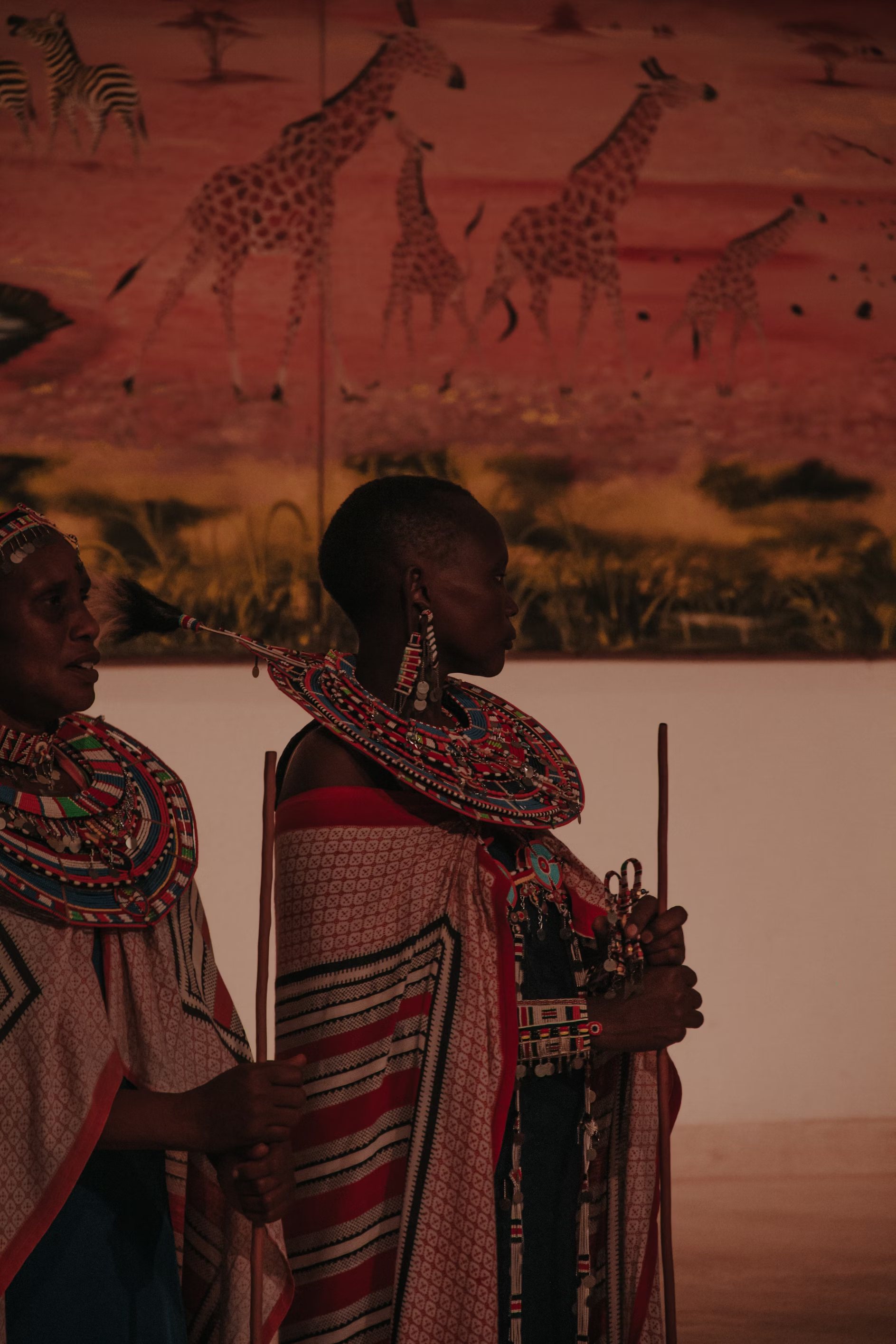
In August 2018, Massah KaiKai, a Sierra Leonean-American development worker, vanished in Freetown just before a planned visit to the U.S. Her sister, filmmaker Oluwaseun Babalola, and their mother, Ayodeji, faced systemic barriers and indifference from authorities in both Sierra Leone and the U.S. Despite a confession from Ibrahim Mansaray, who was convicted of her murder, the family never received formal notification, and the remains were never DNA-tested, leaving them without closure. In response, Babalola created Fighting Giants, a short film blending fact and fiction to depict their emotional journey and the institutional misogyny they encountered. The film aims to raise awareness about the global neglect of missing Black women and highlights the challenges faced by families seeking justice. Through her nonprofit, Kosinima, Babalola supports Black filmmakers, especially women, to share stories often overlooked by mainstream media.
UN-AFFAIRS
DRC, Liberia elected as non-permanent members of UN Security Council
The Democratic Republic of Congo (DRC) and Liberia have secured non-permanent seats on the United Nations Security Council following a vote held on Tuesday at the UN General Assembly. The two African nations will take up their roles in January 2026, serving a two-year term on the world’s most powerful decision-making body for peace and security. The DRC received 183 votes out of 194, while Liberia garnered 181, surpassing the required two-thirds majority despite running unopposed. They will represent Africa on the Council, often referred to as the A3 group, replacing Mozambique and Sierra Leone, whose terms conclude in December 2025. Alongside DRC and Liberia, Colombia (180 votes), Latvia (178), and Bahrain (186) were also elected to the 15-member body. These five incoming members will replace Algeria, Sierra Leone, South Korea, Guyana, and Slovenia. The UN Security Council is the only body within the United Nations with the authority to issue legally binding resolutions, including the imposition of sanctions and the authorisation of military action. To maintain geographical balance, seats are distributed among regional blocs, and even in uncontested races, candidates must still win a two-thirds majority in the General Assembly to secure their seats.
 The Africa Edition ©️
Leave a comment