News That Matters To Africa©️
FRIDAY’S FOCUS EDITION
Good News Africa!
THE FRIDAY QUOTE
“Some roads you just have to take alone. No friends. No family. No partner. Just you…”
HIGHLIGHTS
High court lifts order barring swearing-in of new Kenya deputy president
Blackout cripples Northern Nigeria after jihadist attack
South Africa to strip beauty queen of national ID documents
Mpox cases on African continent show 500% increase.
TOP NEWS
Eastern Africa
A melodic greeting between women in Burundi is at risk of being lost
Video: Why are people boycotting Apple’s new iPhone 16?
PM Abiy announces ongoing talks with armed groups operating in Amhara, Oromia regions
Kenya’s high court lifts order barring swearing-in of new deputy president
Video: Kenya’s DP Gachagua: I have no intention to resign, I’ll fight to the end
IMF approves $606m loan for Kenya
Western envoys concerned about arrests and disappearances as Kenya takes UN rights council seat
French court jails ex-doctor for role in Rwandan genocide
Sudan’s RSF and allies sexually abused victims from 8-75 years, UN mission says
Opposition leader: Stop using security agencies to brutalise Tanzanians
OpEd: Can Tanzania bring East and Southern Africa together on east DRC?
OpEd: What if Dar es Salaam was not meant to grow into this city?
Suspected cult members kill eight kin in Ugandan village
’We are preparing Gen Muhoozi to be next President’ says MP
West Africa
Blackout cripples Northern Nigeria after jihadist attack
Elephants in danger of disappearing in Nigeria
Southern Africa
The hopes and fears of young Botswana ahead of elections
At least 10 people are killed by police in Mozambique post-election protests, medical groups say
South Africa to strip beauty queen of ID documents
South Africa cuts growth projections
OpEd: Can SAMIDRC be spared the fate of previous peace missions?
AFRICA-GENERAL NEWS
GOOD NEWS AFRICA
EASTERN AFRICA
BURUNDI
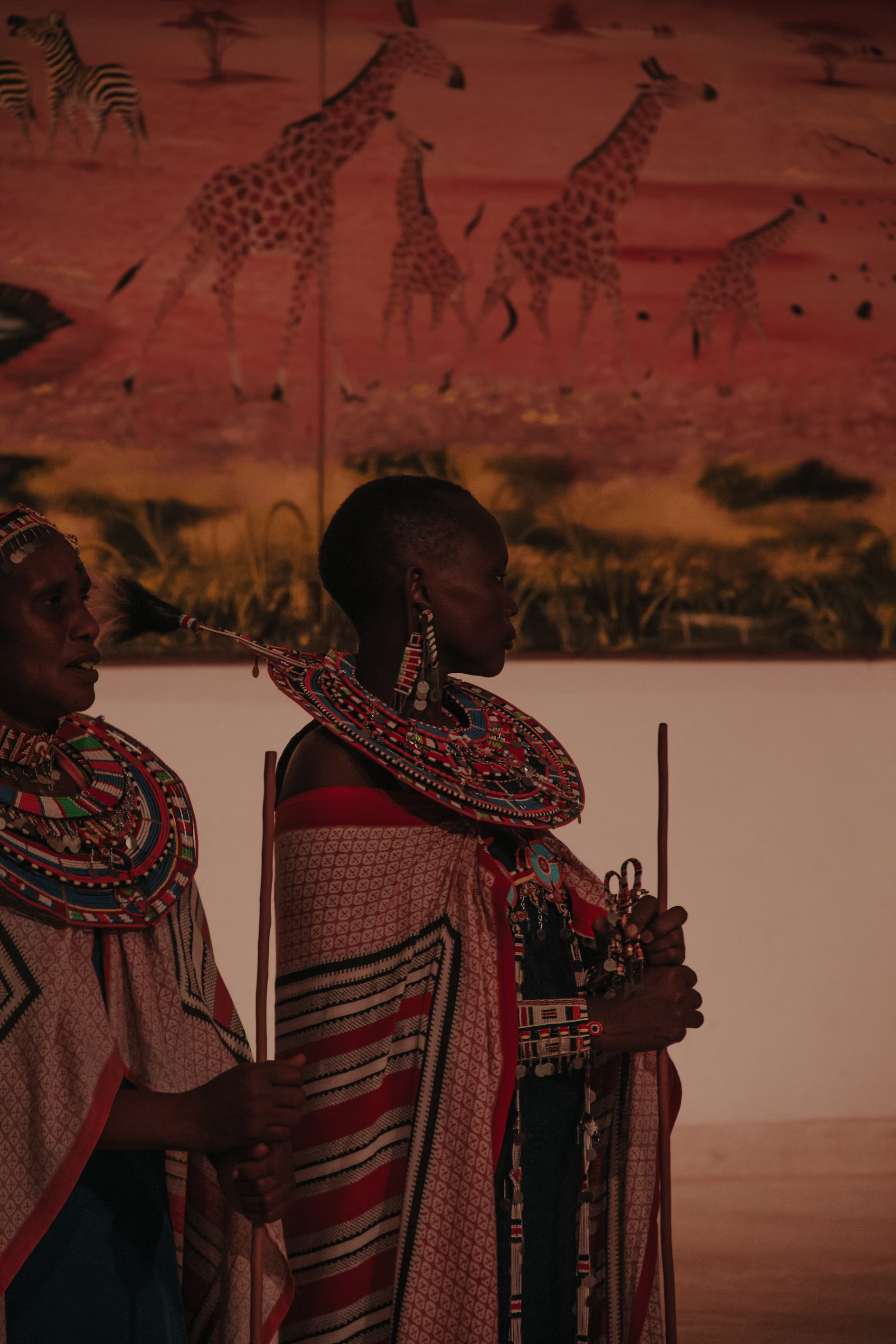
A melodic greeting between women in Burundi is at risk of being lost
The hug between the two women looked like it would last forever. A spirited 85-year-old had embraced a younger woman she hadn’t seen for months, and she chanted a number of questions in the peculiar yodeling routine of her ancestors. A group of neighbors watched in amazement. Many were seeing their first performance of the traditional form of musical greeting, known to Burundians as akazehe. It is performed exclusively by women on a range of occasions. But akazehe is fading, despite its unique status in this central African country that is better known for its world-famous percussionists. That’s according to cultural officials, teachers and others who say the practice is worth preserving. They cited the threat from public health measures that discourage unnecessary contact during disease outbreaks, in addition to the perceived failure to promote akazehe among school-going youth. Among young Burundians, it is hard to find people who know what akazehe means and even harder to find someone who can perform it.
DR CONGO
Why are people boycotting Apple’s new iPhone 16?
Protests and boycotts surrounding the iPhone 16 launch have taken centre stage with thousands gathering outside Apple stores worldwide, from London to Tokyo. Activists chant slogans like “A child died in Congo for your iPhone,” highlighting the exploitation linked to mining minerals in the Democratic Republic of the Congo.
ETHIOPIA
Abiy announces ongoing talks with armed groups operating in Amhara, Oromia regions
Prime Minister Abiy Ahmed addressed the House of People’s Representatives today, 31 October, 2024, announcing that the government has continued talks with “some members” of the armed groups operating in the Amhara and Oromia regions. The Prime Minister also criticized a Member of Parliament (MP) who remarked that the federal government had failed to control the conflict in the Amhara region “within the initial two-month” timeframe.In response, the Prime Minister questioned the credibility of such claims, stating, “It was the assertion that we would control the Arat Killo Palace within two weeks that did not materialize.” According to Abiy, the government has transformed Amhara into an industrial hub over the past six years. He stated, “Those who cannot believe this can go to Kombolcha, Debre Berhan, and Bahir Dar and see the reality.” He further highlighted the government’s efforts to address the region’s road infrastructure. The Prime Minister’s address to the House of People’s Representatives came at a time of renewed conflicts between government forces and the non-state militia group, Fano, which has erupted across various urban and rural areas in the Amhara region over recent months. This recent intensification of conflict, marked by the deployment of heavy weaponry and drone strikes, followed pledges by the Ethiopian National Defense Force (ENDF) and the Amhara regional government to “intensify operations” against armed groups.
KENYA
High court lifts order barring swearing-in of new deputy president
Kenya’s high court on Thursday lifted orders barring the swearing-in of newly appointed deputy president Kithure Kindiki, whose predecessor has launched legal challenges over his removal from office by impeachment. “The office of the deputy president should not remain vacant,” Judge Anthony Mrima said, after the filing of over 30 court cases by Rigathi Gachagua against his ouster. The decision could be appealed to the Supreme Court. Earlier this month the Senate voted to uphold five out of 11 charges against Gachagua, including gross violation of the constitution and stirring ethnic hatred – accusations that he has denied and dismissed as politically motivated. President William Ruto subsequently chose Interior Minister Kithure Kindiki as his new deputy, but a court blocked his appointment. Gachagua’s legal challenges extend months of political turmoil in Kenya, East Africa’s largest economy, that began with nationwide protests against unpopular tax hikes in June.
Video: Kenya’s DP Gachagua: I have no intention to resign, I’ll fight to the end
IMF approves $606m for Kenya
The IMF said it has cleared $606 million in lending to Kenya as it struggles to pay off debts and boost taxes after mass protests led to financial reforms being scrapped. Kenya is considered an economic bright spot in the troubled East African region. But it is grappling with around $80 billion in external and domestic debt, and interest payments are eating up two-thirds of its annual revenue, more than its bills for health or education. An International Monetary Fund review was delayed by protests that broke out in June over a finance bill that aimed to raise some $2 billion through taxes across many areas. Coming on the back of years of high inflation and corruption scandals, the bill sparked unrest that saw more than 60 people killed — and it was eventually scrapped by President William Ruto. “Kenya’s economy remains resilient, with growth above the regional average, inflation decelerating, and external inflows supporting the shilling and a buildup of external buffers, despite a difficult socio-economic environment,” said Gita Gopinath, IMF first deputy managing director, in a statement late Wednesday. “A difficult adjustment path lies ahead,” said Gopinath. “Clearly communicating the necessity and benefits of the reforms is paramount.” She said more support was needed for Kenyan banks and to tackle governance and corruption issues.
Western envoys concerned about arrests and disappearances as Kenya takes UN rights council seat
Western envoys in Kenya have raised concerns over reports of arbitrary arrests and enforced disappearances and urged swift investigations as the country takes up its seat on the United Nations Human Rights Council. In a joint statement on Thursday, the nine ambassadors and high commissioners said they “will support Kenya in corralling the political will necessary to effect change.” Human rights groups have accused the authorities in Kenya of arbitrarily arresting and detaining government critics, while several people have been reported missing and, in some cases, their mutilated bodies discovered days later. Kenya was among several African countries elected to the U.N human rights council on Oct. 9. The envoys’ statement comes days after four Turkish nationals were abducted from Kenya and repatriated despite registering with the U.N as asylum seekers, citing threats to their lives back home. The Kenya National Commission on Human Rights on Thursday said it had investigated 60 cases of extrajudicial killings and 71 cases of abductions and enforced disappearances since June…The deputy inspector general of police, Eliud Kipkoech Langat, said there had been an increase in murder and manslaughter cases and called it a “troubling trend.”
RWANDA
French court jails ex-doctor for role in Rwandan genocide
A French court on Wednesday, October 30 jailed a former doctor to 27 years for his role in the Rwanda genocide, in the latest trial in France over the African country’s massacre three decades ago. Eugene Rwamucyo, 65, was accused of aiding his country’s then authorities to disseminate anti-Tutsi propaganda and of participating in mass murder by attempting to destroy evidence of genocide…He was acquitted of charges of genocide and crimes against humanity…Following an international arrest warrant issued by Rwanda, Rwamucyo was detained in May 2010 by French police following a tip-off by his colleagues in the Maubeuge hospital in northern France, where he was working at the time.
SUDAN
RSF and allies sexually abused victims from 8-75 years, UN mission says
Sudan’s Rapid Support Forces (RSF) and allies have committed “staggering” levels of sexual abuse, raping civilians as troops advance and abducting some women as sex slaves during the more than 18-month war, a U.N. mission said on Tuesday. Victims have ranged between eight and 75 years, said the U.N. fact-finding mission’s report, with most sexual violence committed by the RSF and allied Arab militia in an attempt to terrorize and punish people for perceived links to enemies. “The sheer scale of sexual violence we have documented in Sudan is staggering,” said mission chair Mohamed Chande Othman in a statement accompanying an 80-page report based on interviews with victims, families and witnesses. The RSF, which is fighting Sudan’s army, did not immediately respond to a request for comment. It has previously said it would investigate allegations and bring perpetrators to justice.
TANZANIA
Tundu Lissu: Stop using security agencies to brutalise Tanzanians
Tanzanian opposition leader Tundu Lissu says the citizens of his country have the biggest task to end impunity and police brutality by electing the right leaders…Mr. Lissu condemned the abductions and enforced disappearances of Tanzanians. Mr. Lissu was the victim of attacks by suspected security agents. In 2017, he survived an assassination attempt that left him hospitalized abroad for months, first in Kenya and later in Belgium. His attackers were never identified or arrested. On Tuesday, Mr Lissu said the current abductions and disappearances of citizens were illegal and contravened universal human rights. The reported cases could tarnish the reformist image of President Suluhu, who has been praised for easing the crackdown since succeeding John Magufuli, who died in office in 2021. “We are not surprised that the Tanzanian government is yet to take action against the reported cases of kidnappings. People have been disappearing for a long time since 2015 during President Magufuli’s tenure,” Mr Lissu said. “Government should ensure that its security apparatus is not used to brutalize its own citizens, whether in Tanzania, Kenya, the US or Russia. This is because our domestic laws do not allow kidnapping of citizens.”
OpEd: Can Tanzania bring East and Southern Africa together on east DRC?
OpEd: What if Dar es Salaam was not meant to grow into this city?
UGANDA
Cult members may have killed 8 kin in Ugandan village
Suspected cult members attacked a village in Uganda, killing at least eight people, including a child as young as three and members of the assailants’ families, authorities said on Wednesday. The assault occurred on Tuesday night in Mizizi A, a hamlet in Kagadi district in Uganda’s west, about 250 km (150 miles)from the capital Kampala. Eight others were injured, police said. “Preliminary information indicates that members of a new cult whose name is yet to be established descended on people, most of whom are their family members, and cut them,” the Uganda People’s Defence Forces said. Security forces including from the military and police were on the ground “hunting for the culprits as investigations are ongoing to establish more details about the cult”, it said. Four of those killed were aged under 13, including a three-year-old child, police said. Police said two of the suspected attackers had been killed by security forces as they responded to the assault. Kagadi is near the Kingfisher oilfield, one of Uganda’s two crude oil projects and is operated by China’s CNOOC . There was no indication the oilfield was targeted or involved in any way.
’We are preparing Gen Muhoozi to be next President’ says MP
Daudi Kabanda has sparked fresh discussions about Uganda’s political succession by referring to Gen. Muhoozi Kainerugaba, as a “standby generator” in readiness to assume the presidency. Kabanda, the MP for Kasambya County, made the analogy while hinting at plans to support Gen. Muhoozi’s potential leadership in Uganda’s top office. The metaphor suggests that Gen. Muhoozi is being positioned to step in should Museveni, who has led Uganda since 1986, decide to pass on the leadership baton. His remarks align with recent activities from the Muhoozi Project, a movement advocating for Gen. Muhoozi as Museveni’s successor, suggesting that his role in the nation’s leadership is being seriously considered.
WEST AFRICA
NIGERIA
Blackout cripples Northern Nigeria after jihadist attack
Conflict-ridden northern Nigeria has been plunged into darkness for nearly two weeks after jihadists sabotaged infrastructure, authorities say, depriving millions of electricity and paralysing economic activity. Members of a jihadist group vandalised a major transmission line in Niger state’s Shiroro district, crippling the power supply in 19 of the West African country’s 36 states, according to the state-owned Transmission Company of Nigeria (TCN). Power cuts are common in Africa’s most populous country, where 220 million people depend on a saturated network for their electricity needs. But jihadist attacks on power infrastructure in the north have compounded the problem in recent years.
Elephants in danger of disappearing
Elephants are present throughout Nigerian folklore and culture in parables, sayings, and even in branding — the long defunct national airline used to have an elephant in its logo. But the reality on the ground (sorry) is that elephants are fast disappearing. Nigeria’s elephant population has tumbled from between 1,200 and 1,500, 30 years ago to around 400 today. About two-thirds are forest elephants (pictured), while about 100 are savanna elephants. Tajudeen Amusa, a forestry professor at Nigeria’s University of Ilorin, writes that the remaining elephants are endangered, “threatened by habitat loss and fragmentation, poaching and illegal ivory trade, human-elephant conflict and climate change.” He explains the steps the country has taken to ensure the long-term survival of its elephants.
SOUTHERN AFRICA

BOTSWANA
The hopes and fears of young Botswana ahead of elections
Batswana from different walks of life will head to the polls to decide the fate of the current leader, President Mokgweetsi Masisi, who is seeking reelection under the Botswana Democratic Party (BDP). The BDP has been in power since the country gained independence from the British in 1966, and this time, Masisi will face Duma Boko of the Umbrella for Democratic Change (UDC), Dumelang Saleshando of the Botswana Congress Party (BCP), and Mephato Reatile from the Botswana Patriotic Front (BPF) at the polls. Botswana voters do not directly elect the president. They vote for parties to get seats in the National Assembly, and the newly-elected MPs then elect the president, who is usually the leader of the party with the most seats…On the ground, young Batswana voters are hungry for change and are focused on pressing issues: unemployment, inadequate healthcare, gender-based violence and the lack of government support for the creative industries.
MOZAMBIQUE
At least 10 people are killed by police in Mozambique post-election protests, medical groups say
At least 10 people were fatally shot by police and dozens of others were injured when authorities cracked down on unrest following Mozambique’s presidential election, two medical groups said, as the country braced Thursday for more protests against a vote criticized as fraudulent by opposition parties and questioned by international observers. Daniel Chapo of the ruling Front for the Liberation of Mozambique was announced as the winner of the election on Oct. 24, extending the Frelimo party’s 49 years in power since independence from Portugal in 1975. Chapo is to succeed President Filipe Nyusi, who is stepping down after serving the two terms allowed under the constitution. Frelimo has regularly been accused of rigging elections and Mozambique’s security forces have previously been criticized for suppressing protests with deadly force. Opposition parties claimed fraud on the day of the election, while observers from the European Union said in a later report that there were irregularities in the vote counting and some results had been altered.
SOUTH AFRICA
Authorities to strip beauty queen of ID documents
Beauty queen Chidimma Adetshina, who has been at the centre of a fierce nationality row, is to be stripped of her South African identity and travel documents. The Department of Home Affairs began investigating her case after she became a finalist in the Miss South Africa pageant, but faced criticism as people questioned her eligibility to compete because her mother has Mozambican roots and her father is Nigerian. She withdrew from the competition in August after the department announced that her mother might have committed “identity theft” to become a South African national. Ms Adetshina, a law student, went on to win Miss Universe Nigeria after she was invited to participate by the organisers. The Department of Home Affairs made the announcement about the withdrawal of her ID papers to a parliamentary committee on Tuesday. Tommy Makhode, the top civil servant at the department, said Ms Adetshina’s mother would also have her documents cancelled as they had both failed to meet Monday’s deadline to provide reasons why they should be eligible to keep them. Neither Ms Adestshina nor her mother have commented on the move to revoke their papers. Mr Makhode said the case had been referred to the Hawks, a special police unit that investigates serious crimes, which had concluded that it was a “case of fraud” – and officials were awaiting on prosecutors about how to proceed.
Pretoria cuts growth projections
South Africa’s government unveiled grim budget forecasts on Wednesday, cutting its projections for economic growth. Finance Minister Enoch Godongwana, in the coalition government’s first half-year budget, cut the growth target for this year to 1.1% from the 1.3% target set by the previous administration. Pretoria is set to cut spending in a bid to reduce debt and narrow budget deficits. The latest estimates highlight the scale of the challenge facing Africa’s most industrialized economy. Electricity shortfalls in recent years, coupled with problems at state-run rail and ports company Transnet, have curtailed growth and thus tax intake. South Africa’s coalition, formed after the African National Congress lost its parliamentary majority following elections in May, has until now been buoyed by hopes that South Africa could regain economic momentum amid positive investor sentiment and improved electricity provision.
OpEd: Can SAMIDRC be spared the fate of previous peace missions?
AFRICA-GENERAL NEWS

Mpox cases on African continent show 500% increase year-on-year
Mpox cases continue to spread on the African continent, showing an increase of over 500% from last year, data from the Africa Centres for Disease Control and Prevention (Africa CDC) showed on Thursday. The World Health Organization declared mpox a global health emergency in mid-August, after a new strain began spreading from the Democratic Republic of Congo to neighbouring countries. “The situation is not yet under control, we are still on the upward trend generally,” Ngashi Ngongo from Africa CDC told a briefing. Nineteen African countries have seen more than 48,000 suspected mpox cases including 1,048 deaths so far this year, according to the public health agency’s data. Central Africa, which is the most hit by the outbreak, accounts for 85.7% of cases and 99.5% of deaths on the continent. The virus can be transmitted through close physical contact, including sexual contact. Its new strain, known as clade Ib, is also spreading to Europe and was detected in Sweden, in Germany and in Britain.
African migration trends up
More than a third of Africans want to live somewhere else, a new high, according to a 2023 survey by Gallup. In 2012, 29% wanted to migrate; last year the number was 37%. Not everyone wants to leave. While more Zambians want to migrate — up 13 percentage points — there was a 15 percentage point drop in Gabon. Still, the continent’s overall increased longing to set up home elsewhere mirrors global trends. Some 16% of the global adult population in 2023 wanted to move to a different country, compared with 12% a decade ago. Even in the United States and Canada — the top two destinations for all aspiring migrants over the past decade — more people said they wanted to move abroad, compared to the previous survey. Only in the European Union was the percentage stable, Gallup said.
OPEDs:
Why are African artists like Tyler forced to strip their identities for global stardom?
Answer to crisis of democracy, African state lies in Arusha. Will region take it?
US-Africa relations under Biden: a mismatch between talk and action
Brics+ could shape a new world order, but it lacks shared values and a unified identity
Autocrats and cities: how capitals have become a battleground for protest and control
GOOD NEWS AFRICA
News:
“Queen of African Media” Mo Abudu on the Need to Ban the “Tokenism of Black Content”
The Nigerian mogul, CEO of EbonyLife Media, was named one of The Hollywood Reporter’s 2024 Most Powerful Women in International TV. Mo Abudu likes to joke that when she decided, in her mid-40, to change careers, from being an executive at oil giant ExxonMobil to launching her own media empire, “most people thought it was a mid-life crisis.” Nearly two decades later, the oft-styled “Queen of African media” has proven the doubters wrong. At 60, Abudu’s influence continues to grow. Her conglomerate EbonyLife has teamed up with African Export Import Bank (Afreximbank) to finance and produce African content for international distribution. Its first project, the family drama, Dust to Dreams, will see Idris Elba direct singer Seal and Nigerian stars Nse Ikpe-Etim, Eku Edewor, Atlanta Bridget Johnson, and Constance Olatunde. Despite her success, Abudu acknowledges the challenges women still face getting ahead in the entertainment industry…Looking to the future, Abudu says she hopes we’ll soon see the end to what she calls “tokenism of Black content,” internationally, where shows with Black characters and storylines “only get one chance, and then that’s it for the next five years. This same logic never applies to ‘white’ shows”.
Kenyan Peter Ngugi cycled through 7 states in India to tackle racism
In the winter season in Delhi, India, in the year 2016, what started as a minor altercation powered by racism ended up in the death of an African.
Two Indians assaulted a Congolese teacher who refused to let them have the rickshaw he was hiring. The shocking murder in the open streets of India was also the final straw for Peter Ngugi, a Kenyan living in India at the time. He picked up his bicycle and cycled across the country to combat racism – in the process ‘breaking the internet’ and becoming news himself, in the days following the callous murder.
The man battling Nigeria’s ‘witch-hunters’
Activist Leo Igwe is at the forefront of efforts to help people accused of witchcraft in Nigeria, as it can destroy their lives – and even lead to them being lynched. There has been seen evidence of Pentecostal pastors in Nigeria holding services targeting alleged witches, a practice Dr Igwe says is not unusual in a country where many people believe in the supernatural. Dr Igwe set up Advocacy For Alleged Witches…and his prevention work also extends to Ghana, Kenya, Malawi and Zimbabwe and beyond. One of the people the organisation has helped in Nigeria is 33-year-old Jude, accused of causing the disappearance of a boy’s penis through witchcraft, an accusation that shocked him and is untrue. Claims of manhood disappearances are not uncommon in some parts of West Africa. On WhatsApp, Dr Igwe is something of an influencer. Over the last few years he has built and curated WhatsApp groups for different Nigerian states. These groups are full of dozens of concerned citizens who he dubs “advocates”. They share viral witch-accusation videos and photos and try to intervene when an allegation is being made on their patch.
Born in France but searching for a future in Africa
Menka Gomis was born in France but has decided his future lies in Senegal, where his parents were born. The 39-year-old is part of an increasing number of French Africans who are leaving France, blaming the rise in racism, discrimination and nationalism – a phenomenon being referred to as a “silent exodus”. Mr Gomis’s mother moved to France when she was just a baby and cannot understand his motivation for leaving family and friends to go to Senegal. He explains that “Africa is like the Americas at the time of… the gold rush. I think it’s the continent of the future. It’s where there’s everything left to build, everything left to develop.” In Senegal itself, migrants are willing to risk their lives in dangerous sea crossings to reach Europe. Many of them end up in France where, according to the French Office for the Protection of Refugee and Stateless Persons (OFPRA), a record number sought asylum last year. It is not clear how many are choosing to do the reverse journey to Africa as French law prohibits gathering data on race, religion and ethnicity. But research suggests that highly qualified French citizens from Muslim backgrounds, often the children of immigrants, are quietly emigrating.
How can Africa break free from negative stereotypes?
International media organizations often perpetuate outdated stereotypes abut Africa, such as corruption, disease, poor leadership, violence and poverty, according to Abimbola Ogundairo, advocacy and campaigns lead with Africa No Filter, an NGO that challenges harmful narratives about the continent. A study by Africa No Filter and consulting firm Africa Practice revealed that such negative portrayals create a monolithic view of the continent, misrepresenting Africa’s diverse realities. This skewed coverage amplifies perceived risks, increasing borrowing costs and discouraging investment — especially during elections, when the focus on negative issues such as violence and election fraud is disproportionally high compared to similar political risks in non-African countries. “When a singular story is being told over time, it now starts to diminish the identity of a place to just that one thing,” states Ogundairo. For example, 88% of media articles about Kenya during election periods were negative, compared to only 48% for Malaysia during its elections. As a result, international investors view African countries as riskier than they actually are. African borrowers lose up to $4.2 billion (€3.9 billion) annually in interest payments on its loans primarily due to stereotypical narratives, according to the study. Positive media sentiment is correlated with a lower risk profile and reduced bond yields while negative media coverage increases a country’s perceived risk, which leads to higher borrowing costs.
Art, Music, Film and Culture:
A playwright in Africa hopes to break the cultural silence on rape
Oliva Ouedraogo’s play “Queen” (known by its French name “Reine”), depicts the fictional journey of a girl who is raped by her stepfather on the night of his marriage to her mother, and decides to speak out against her family’s wishes. Ouedraogo said she wrote the play to address the culture of silence about rape and sexual assault. She said what pushed her to write “Queen” was her anger that rape victims feel obliged to stay quiet in order to avoid familial conflict. In Mali, gender-based violence is widespread and underreported. A 2018 health survey by the Malian National Institute of Statistics reported that 45% of women aged 15-49 have experienced physical or sexual violence in their lives – 68% have never spoken about it to anyone. Ouedraogo said that she hopes that governments can prioritize laws that protect victims, and that talking about sexual assault in the open can encourage them to speak about it and get help.
The world twins festival in Nigeria – in pictures
Nigeria’s ‘twins capital of the world’ Igbo-Ora holds its annual festival to celebrate the town’s unusually high incidence of multiple births.
How a beloved Lagos art fair keeps showing up for fans
Art X Lagos will hold its 9th edition from Oct. 31 to Nov. 3. Previous editions have hosted exhibitions from over 400 African artists from 70 countries featuring more than 120,000 visitors from around the world. Tokini Peterside-Schwebig, the fair’s founder, expects it to showcase the evolution of global perceptions of African art and artists. Interview:
Empalikino
Empalikino (“Forgiveness”) produced during a recent Safari StoryLab training. Witnesses in the room reported the audience as moved to tears underlining the immense power stories have to touch hearts, deepen connections, and inspire change. This is why “we do what we do – so the world will know, feel, and be inspired to act for Africa’s incredible wildlife”.
He knew this was going to be the last story he wrote’: the epic legacy of literary maverick Biyi Bándélé
The film-maker, playwright and novelist finished his last book, Yorùbá Boy Running, the day before he took his own life in August 2022. He left behind an impressive and strikingly varied body of work: the film adaptation of Chimamanda Ngozi Adichie’s Half of a Yellow Sun, which took seven years to make; stage versions of Chinua Achebe’s Things Fall Apart, Aphra Behn’s Oroonoko and Lorca’s Yerma; poetry, screenplays and several novels including 2007’s Burma Boy, which told the story of his father’s harrowing and brutal experiences as a British army soldier in the second world war. His was a talent unrestrained by genre, medium, geography or period.
Community is everywhere – even in Silicon Valley
San Jose, where black people make up only 2.9% of the residents, is an unlikely place for an African film festival. Yet, from 10 to 13 October, San Jose’s Historic Hoover Theatre is where we were able to pal around with icons like Souleymane Cissé, the Malian who is hailed as Africa’s greatest living filmmaker, and King T’Chaka himself, John Kani (Black Panther). When the Silicon Valley African Film Festival (Svaff) started, it was a single-day screening of a handful of films by African filmmakers. This year – its 15th year – it served up 85 films from 38 countries. Festival director and founder, Chike Nwoffiah insists on creating a communal environment, and that is what sets the Svaff apart. Without regard to hierarchies, guests settled into a group dynamic that empowered all voices. Even the big names honoured this spirit. “It is an opportunity to talk to each other, know each other, and to ask the elders questions,” said Kani, who – like Cissé – is now in his 80s. Svaff honoured the icons back, presenting “Cultural Icon” awards to Cissé, whose 1987 masterpiece Yeelen was the first African film to win a jury prize at Cannes; the Tony award-winning Kani; Julie Dash, whose 1991 film Daughters of the Dust remains a landmark of Black cinema; and Nigerian actor Richard Mofe-Damijo.
Abidjan Fashion Week
$520,000. It is the budget for the very first Abidjan Fashion Week which took place in the commercial capital of Côte d’Ivoire from Oct. 10-13. It was successfully pulled together by the Ivorian designer Elie Kuame and his team with a third of the budget backed by ticket sales, and the rest by private sponsors and the Ivorian culture ministry. The Week’s shows were described as “flamboyant” by Le Monde Afrique, which noted the predominance of local designers but also work from neighbors including Ghana, Benin, Nigeria, Senegal, and Cameroon.
Environment:
How a Kenyan schoolgirl fell in love with trees
A 14-year-old girl from Kenya has achieved global fame for her efforts to save the planet, meeting the likes of King Charles and teaming up with Grammy award-winner Meji Alabi and ex-football star David Beckham in the campaign against climate change. Ellyanne Wanjiku Chlystun was just four years old when she was motivated to act on the issue with her inspiration coming from Kenya’s most-famous tree planter and Nobel laureate, Prof Wangari Maathai. “I was doing a project in kindergarten about people who had made a difference in the world, such as Martin Luther King, Nelson Mandela and Florence Nightingale…She says that she had personally planted about 250,000 trees by 2020, but had built a “community” of tree-lovers – not just in Kenya but also abroad – and together they had crossed the 1.3 million mark. “I have planted trees all over the world in countries I have visited, including Uganda, Poland, the UK, Crater Lake in the USA, Zanzibar, Morocco and Zambia,” Ellyanne says, adding: “I have planted the most trees here in Kenya.” She attended the climate summit in Dubai in 2023, where she met the British monarch, and gave a speech that drew a link between climate change and the water-borne disease malaria.
Africa’s road map to a bigger, greener power system
Africa may be set to transform itself from a relative clean-energy laggard into a power-sector pioneer. African power firms have plans to dramatically expand the continent’s energy generation base and make it far cleaner. This could help fuel Africa’s expected economic acceleration over the coming decades and provide jobs for its population of roughly 1.5 billion. But the key will be execution. The continent’s power companies are seeking to sharply boost clean-power generation, cut reliance on fossil fuels and nearly double total power output by the time projects near or under construction are completed. But realizing these plans will require overcoming major obstacles, including a lack of energy policy coordination among nations, outdated existing energy infrastructure and limited experience operating regional power pools. All told, there are around 32,700 megawatts (MW) of clean- power capacity under construction across Africa, and around 60,000 MW of clean-power capacity already in operation. African power firms are, in aggregate, currently building 250 megawatts (MW) of geothermal plants, nearly 5,000 MW of wind projects, 8,100 MW of solar parks, 15,600 MW of hydro dams, 3,600 MW of nuclear capacity, and around 120 MW of bioenergy capacity.
How hiking became Nairobi’s new outdoor escape
Escape the city and discover Nairobi’s growing hiking culture. The 77 Percent joins the outdoor start-up Let’s Drift and its founder Alex Kamau on a hike in the forests outside Nairobi. The aim, to explore nature and connect with Kenya’s growing outdoor community.
Surf’s up! Riding the waves with the boarders of Busua, Western Ghana
Busua is a small fishing village in south-western Ghana. A six-hour drive from Accra, “it’s a place where you feel totally disconnected from the town”, says Sandy Alibo, who first visited in 2016. Working in the action sports division of French telecoms brand Orange, she couldn’t help but take note of Busua’s surfing scene. The conditions were perfect, but “there was no African representation”, she says. “It was a service dedicated to tourists.” Born in Martinique, Alibo had always felt like the only Black woman in the board sports industry. Visiting Busua gave her a new sense of purpose: to create a truly Ghanaian surf community, befitting the miles of pristine shores lining the country’s southern coast. She made an Instagram account (@surfghana), where local surfing communities could show off their skills, later relocating to Accra to establish a surfing and skateboarding collective…“The main goal of Surf Ghana was to develop a local surf community,” says Alibo, “but naturally it created interest among tourists.” She sees this as an opportunity to steer visitors towards Ghanaian-owned businesses: the Ahanta Waves and Justice’s Brothers surf schools in Busua, Loshe’s Surf School in Cape Three Points and Joshua’s Surf School in Kokrobite, close to the capital…Alibo also wants to raise some world-class surfers. Established earlier this year, Sankofa Surf Club is a team of 14 boys aged between six and 21, who train every day with leading coaches. Girls are welcome, says Alibo, but they currently have their own Obibini Girls Surf Club next door.
Health:
‘People didn’t believe Africa could be a source of innovation’: how the continent holds the key to future drug research
Africa has the greatest variety in human genes anywhere on the planet but the world is failing to capitalise on it, according one of the continent’s leading scientists, Prof Kelly Chibale, a man determined to change that. He believes the birthplace of humanity could hold the scientific key to its future. About 18% of the global population lives in Africa – a proportion set to rise over the next few decades – and it accounts for 20% of the global disease burden. But only 3% of clinical trials take place on the continent, and most of those in just two countries – South Africa and Egypt. “I would argue that actually, if you really want to have confidence in a clinical trial, it must start in Africa. Why? If it works in Africa, there’s a good chance it’ll work somewhere else, because there is such huge genetic diversity,” says Chibale, of the University of Cape Town. Testing a drug in people with a wider variety of genes, rather than the historic standard of a Caucasian man, means the frequency and amount of a drug given to patients can be better calibrated for everyone before it gets to market. It is an “opportunity”, Chibale says, but will require persuading more African people to volunteer to take part in research, and governments will need to be more open to hosting trials.“ The status quo is that innovative medicines are discovered and developed largely in the global north. Then, five to 10 years later, those innovative medicines are brought to Africa.” It means there is no certainty that those drugs will work in African populations, or fit into the way medicine is practised across the continent, Chibale says – offering as an example a greater reliance on traditional remedies as the first option, which can mean patients present to hospitals later than in western countries.
South Africa: Men in heels against male breast cancer
Superfood ‘red espresso’ made from South African tea takes off globally
On a sun-parched plateau, high in South Africa’s rugged Cederberg mountains, Boltwin Tamboer harvests rooibos tea in much the same way his forefathers would have done. Some of this crop will be used as traditional tea. And, thanks to the growth of a newly imagined beverage, some will end up, curiously, in espresso machines. Tamboer’s San (also known as Bushmen) ancestors were the first to discover the healing properties of the yellow-flowered shrub, which grows only in the Cederberg in the Western Cape, 250 km (155 miles) from Cape Town. The Europeans who arrived in the hostile, drought-prone region in the 18th century cultivated rooibos, or Aspalathus linearis, and brought its red tea to a broader market. Rooibos tea is a South African staple. Every kitchen in the country boasts a box of the soothing brew that’s often given to colicky babies and drunk – with loads of milk and sugar – at church gatherings and PTA meetings. But rooibos has never been considered an exciting or trendy beverage. Husband and wife team Pete and Monique Ethelston decided to change that while on a life-altering trip. After learning that the humble tea was capable of more depth and flavour and could even be used as a coffee substitute, or a kind of red “espresso”, they began a business that would change the way people saw and experienced rooibos…By 2008, Red Espresso was voted Best New Product by the Speciality Coffee Association of America. While the company has made significant efforts to advance its own prospects, it has also benefited from the global shift towards health and wellness – expected to be a $7-trillion global industry by 2025.
A colorful kite festival in South Africa raises awareness for mental health
Enthusiasts flew kites of all shapes and sizes Sunday at a festival in South Africa that raises awareness for mental health and provides a burst of beachside color. The Cape Town International Kite Festival is celebrating its 30th year, with participants traveling from the United States, Tunisia and elsewhere. They ranged from seasoned pros — there is such a thing as professional kite fliers, according to organizer Barbara Meyer — to children who skipped down the sand with kites fluttering above them. Kite designs included “Finding Nemo”-inspired fish, blue dragons, yellow lizards and a wiggly green jellyfish. One inventive entrant was a kite in the shape of a skydiver. Another was a giant hand that flew above spectators, waving in the wind. October is mental health month in South Africa. Meyer said the festival is an important fundraiser for Cape Mental Health, an organization that offers largely free counseling to any who need it in the Cape Town area. She said the last few years had been tough for many with the mental scars of the COVID-19 pandemic, especially young people. “There were so many different layers that COVID brought to people,” she said. “People lost family members. The issue of isolation and lockdowns made it worse. There were a lot of job losses as well and a lot of people coming and asking for help.”
Sports:
Commentary: Rumble in the Jungle 50 years on: how Ali danced rings around apartheid
African player numbers tie NBA record
A record-equalling 17 players from African countries featured on NBA rosters for the opening night of the 2024/25 season this week, even as the league eyes greater popularity in Africa and more talent from the continent. Data shows that the number of players from African countries in the league has grown at pace over the past decade, from just six in 2014. The growth of the NBA’s African contingent is starting to benefit from its ramped up activities on the continent, particularly its talent development programs. Cameroon’s Ulrich Chomche, the first-ever prospect directly selected from the NBA Academy Africa in Senegal to the NBA, was the youngest player to be picked in this year’s NBA Draft at age 18. He scored for the Toronto Raptors against the Cleveland Cavaliers in his NBA debut last Wednesday. Cameroon boasts the most players from the continent in the league, with five. Among them is the 22/23 league MVP and Philadelphia 76ers star Joel Embiid, who was born in Yaoundé, but represents the United States internationally. Others include the New Orleans Pelicans’ 20-year-old center Yves Missi, who recently made a strong NBA debut against the Chicago Bulls — scoring 12 points, 7 rebounds and one assist. Nigeria had four players on opening night rosters, including Precious Achiuwa for the New York Knicks, Josh Okogie for the Phoenix Sun, Adem Bona for the 76ers, and Charles Bassey for the San Antonio Spurs. Other African countries represented on the rosters include the DR Congo, Angola, South Sudan and Sudan. The rosters also featured more than 35 players with at least one parent from an African country. They include 2023-24 NBA Rookie of the Year Victor Wembanyama, who has ties to the DR Congo, three-time NBA All-Star Bam Adebayo, who has ties to Nigeria, and two-time NBA MVP Giannis Antetokounmpo who also has roots in Nigeria.
Tech, Business, Trade:
Tanzania’s first electric train could supercharge economic development in East Africa
A new Tanzanian railway could supercharge economic development in East Africa. Authorities in the country hope its first electric-powered train — which connects the country’s capital Dodoma with the port city of Dar es Salaam — will kickstart other rail projects in neighboring countries, turning Tanzania’s line into the gateway to the Indian Ocean. The US and China are vying for influence over the continent’s rail industry, with both deploying hundreds of millions of dollars in financing for train lines, the International Railway Journal reported. Experts believe at the heart of the tussle lies a battle for resources, including for metals and minerals essential for the green transition. African leaders fear getting “trapped in a new cold war.”
Uganda Is East Africans’ Darling Investment Nation. The Unsual Reasons Why It’s A Winner
More East Africans are investing in Uganda than other East African Community economies, with the country snagging 38% of the investment value from 67 projects, says the EAC Trade and Investment Report. In the five years to December 2023, East Africa grossed $2.71Bn from 345 INTRA-REGIONAL projects, of which Uganda got $1.04Bn of it. Kenyan firms and individuals invested more in Uganda more than in any other EAC country, plowing in $606.22M in 50 projects. It was followed by Tanzania and Rwanda with investments worth $164.33M and $44M respectively. The report doesn’t explain why, but @DailyMonitor (see linked story) quotes the top Ministry of Finance official saying Uganda has the least foreign exchange risk. It has the region’s most stable currency (and its freest), which has depreciated by only 0.33% in the past five years. Not much reported, one would add that it has surpassed Kenya to have the most laissez fare economy in the region. Uganda also has a very benign attitude towards foreigners and bigger foreign businesses – they might squibble with the smaller ones.
More @cobbo3 on “X”
OpEd: Inside Dakhla, the potential trade and tourist hub between the Sahara and the Atlantic
Google adds 15 more African languages on ‘Voice Search’
15 more African languages have been added on Voice Search, typing with voice on Gboard and voice input on Translate. In Kenya and East Africa, Google says it is expanding its offering on Voice Search and Gboard with the addition of Somali, Kikuyu, Rundi, Tigrinya, Amharic and Oromo, alongside Kiswahili and Dholuo. In West Africa, Google now supports Twi, one of the most widely spoken languages in Ghana, as well as 4 major languages of Nigeria, a country with over 500 languages and 218 million people. Hausa, Yoruba, Igbo and Nigerian Pidgin are spoken by an estimated 129 million people, or around 60% of Nigeria’s population. The language extension has been made possible by advances in AI, specifically multilingual speech recognition – which converts speech into text. “This technology will make a difference to over 300 million more people across the continent – enabling them to interact with the web with just their voice.
Fifty thousand to receive training in AI
50,000 – the number of developers from across Africa set to receive skills training from chip giant Nvidia, in partnership with pan-African tech talent company Gebeya. The initiative aims to create an ecosystem of Nvidia-certified developers with specialized skills in areas including artificial intelligence. Wei Xiao, Nvidia developer relations director, said in a statement that Africa has a “nearly unlimited opportunity in AI” thanks to its large developer base. One aim of the program is to help position Africa as a hub for AI expertise and attract investments, she said.
Falling cost of space flight makes room for African companies
The fast-falling cost of rocket launches has opened up space exploration to African companies, with several smaller nations in the continent rushing to develop their space programs. So far, 17 African countries have put more than 60 satellites into orbit, with several others expecting their operations to begin in the coming months, the BBC reported. According to a report by business consultancy McKinsey, the price of heavy launches to low-Earth orbit has fallen around 95% to just $1,500 per kilogram, with some estimates suggesting it could fall to as little as $100. Africa has budgeted $400 million for space development for 2024, according to Space in Africa. Space-based products and services could play a “critical role” in meeting Africa’s sustainable development goals, UK think tank Chatham House wrote. Satellites enable global communications and monitor natural resources and climate cycles — crucial information for a continent particularly vulnerable to climate change, an expert told the BBC. Both the US and China have heavily invested in African space technology. To that end, China has helped to launch satellites from several African countries, including Ethiopia and Egypt. The US, meanwhile, has focused on space as a means to advance Africa toward its development goals — and counter China: US National Reconnaissance Office and NASA officials have expressed increasing concern over China’s growing influence in space exploration, with NASA’s chief warning of a new Cold War-like “space race” between Washington and Beijing.
Tanzanian breeder cashes in on valuable all-black chicken
Luxury leather bags from Lesotho
Lesotho’s leather processing fell into oblivion from the 1980s onwards. Now a dynamic duo is working to revive it and bring Lesotho back onto the world stage with a range of luxurious leather bags!
History:
A general history of African explorers of the Old world, and a 19th century Bornu traveller of twenty countries across four continents
This article provides a brief outline of over sixty African explorers who traveled across the ‘Old World’ from the classical period to the turn of the 20th century. The linked articles and the footnotes include sources on individual travelers for further reading.
An empire of cloth: the textile industry of the Sokoto empire ca. 1808-1903
The Hausaland region of northern Nigeria was home to one of the largest textile industries in pre-colonial Africa, whose scale and scope were unparalleled throughout most of the continent. As one German explorer who visited the region in 1854 noted, there was ‘something grand’ about this textile industry whose signature robes could be found as far as Tripoli, Alexandria, Mauritania, and the Atlantic coast. Centers of textile production like Kano were home to thousands of tailors and dyers producing an estimated 100,000 dyed-robes a year in 1854, and more than two million rolls of cloth per year by 1911. Much of the industry’s growth was associated with the establishment of the empire of Sokoto in the 19th century, which created West Africa’s largest state after the fall of Songhai, and expanded pre-existing patterns of trade and production that facilitated the emergence of one of the few examples of proto-industrialization on the continent. This article explores the textile industry of the Sokoto empire during the 19th century, focusing on the production and trade of cotton textiles across the Hauslands and beyond.
 The Africa Edition ©️
Leave a comment